Rare Earth Element Market: USD 31.55 Billion Outlook as EVs and Renewable Energy Accelerate Demand
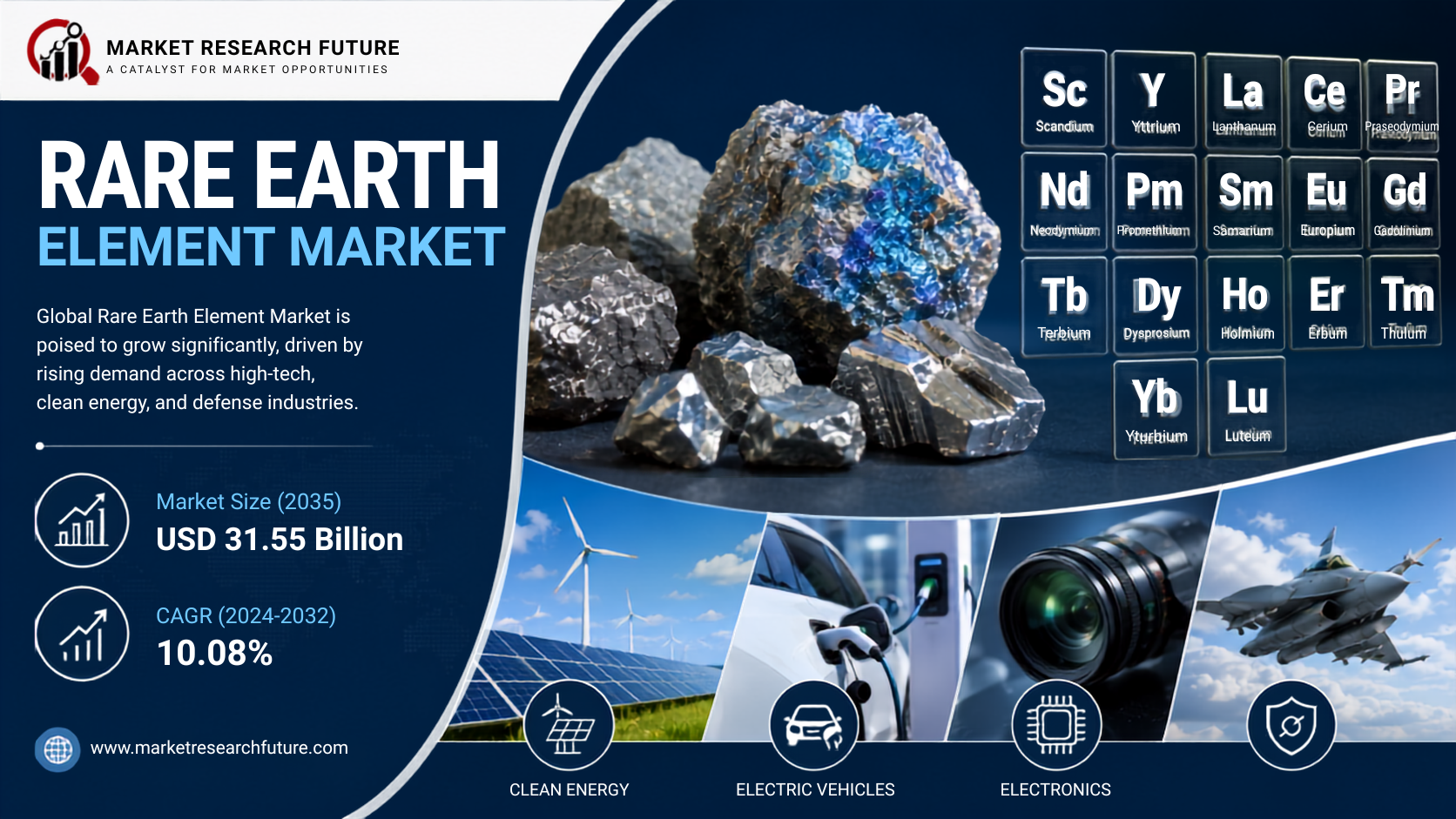
BEIJING , CHINA, August 26, 2026 /EINPresswire.com/ -- The global rare earth elements market is entering a period of extraordinary expansion that will fundamentally restructure one of the world's most strategically consequential supply chains. Valued at approximately $11.78 billion in 2025, the market is projected to climb from $13.29 billion in 2026 to roughly $31.55 billion by 2035, registering a compound annual growth rate of 10.08%. This trajectory is being driven by an insatiable demand pull from electric vehicle traction motors, direct-drive offshore wind turbines, and next-generation defense platforms, all of which depend on permanent magnets that cannot be manufactured without these seventeen chemically similar metals. Simultaneously, Western governments are channeling billions of dollars into supply chain reshoring initiatives that are slowly prying open a market long dominated by Chinese state-owned enterprises.
Application Landscape: Automotive and Electronics Neck and Neck, Renewable Energy Surging
By application, automotive and electronics are virtually tied as the largest segments in 2025, with automotive generating approximately $3.15 billion and electronics contributing roughly $3.14 billion. However, their growth trajectories are diverging. Automotive demand is expanding at a 10.78% compound annual growth rate, outpacing electronics at 9.91%, as the global vehicle fleet transitions from internal combustion engines to electric drivetrains. Each electric vehicle requires substantially more rare earth content than its conventional predecessor, primarily in the traction motor, power steering systems, and sensor arrays.
Renewable energy is the fastest-growing application segment, advancing at a 14.07% compound annual growth rate. This acceleration is driven by the exponential buildout of direct-drive offshore wind capacity across Europe, North America, and Asia. Each offshore wind turbine requires approximately 600 kilograms of NdFeB permanent magnets, and government net-zero commitments including the U.S. Inflation Reduction Act and the European Union's REPowerEU plan provide structural demand support through the entire forecast period. By 2035, renewable energy is projected to rival or exceed automotive as the largest application segment.
The defense segment, while the slowest-growing at a 5.42% compound annual growth rate, provides uniquely stable demand insulated from commercial cycles. Valued at approximately $1.09 billion in 2025, defense applications span precision-guided munitions, satellite systems, radar arrays, and hypersonic platforms. The strategic importance of these applications transcends their revenue contribution, driving government stockpiling programs that create guaranteed demand floors. Other applications, including petroleum refining catalysts, glass manufacturing, metallurgy, and water treatment, contributed approximately $2.08 billion.
Request Sample Copy: https://www.marketresearchfuture.com/sample_request/24834
Ore Types: Bastnasite Anchors Supply, Xenotime Commands Premiums
Bastnasite remains the dominant commercial ore type, generating approximately $7.21 billion in 2025 and accounting for roughly 61% of the market. This dominance reflects its status as the primary ore mined at the world's two largest rare earth operations: China's Bayan Obo mine and MP Materials' Mountain Pass facility in California. Bastnasite's favorable metallurgy and established processing infrastructure make it the workhorse of global supply.
However, xenotime is the fastest-growing ore segment, projected to expand at a 12.77% compound annual growth rate. This acceleration is driven by intensifying demand for the heavy rare earths it contains, particularly dysprosium and ytterbium, which are essential for high-coercivity permanent magnets capable of operating at the elevated temperatures found in electric vehicle motors and defense systems. As demand for heavy rare earths outpaces supply, xenotime deposits command premium pricing and attract disproportionate investment. Monazite, a thorium-bearing phosphate mineral recovered as a co-product of titanium and zircon mineral sands mining, generated approximately $2.45 billion in 2025 and is growing at a 9.85% compound annual growth rate as Australia, India, and Brazil expand their mineral sands processing operations.
Regional Landscape: Asia-Pacific Dominates, Western Reshoring Accelerates
Asia-Pacific commands the global rare earth elements market by an overwhelming margin, generating approximately $9.45 billion in 2025 and representing over 80% of global revenue. The region is also the fastest-growing, with a projected compound annual growth rate of 10.55%. China's control of the entire rare earth value chain, from mining at Bayan Obo and southern ion-adsorption clay deposits through separation, oxide production, metal refining, alloy production, and magnet manufacturing, gives it unparalleled market influence. China alone accounts for roughly 75% of regional revenue. China Northern Rare Earth Group's expansion of separation and smelting facilities in the Baotou region in April 2025 exemplifies ongoing upstream capacity growth that further consolidates Chinese supply leadership.
Japan contributes approximately 12% of Asia-Pacific revenue despite limited domestic resources, operating the world's leading sintered NdFeB magnet industry through Shin-Etsu Chemical and TDK. Australia's Lynas Rare Earths operates the only significant non-Chinese rare earth mine at Mt Weld and commissioned a new heavy rare earth processing facility in Malaysia in October 2025, adding 5,000 tons per year of processing capacity. This facility represents one of the few commercially operational heavy rare earth processing plants outside China. India, capturing roughly 4% of regional revenue, is expanding Indian Rare Earths Limited's monazite processing operations and has identified rare earths as a strategic mineral under its critical minerals policy.
North America holds the second-largest position by strategic value concentration, generating approximately $1.53 billion in 2025 and growing at a 7.91% compound annual growth rate. The United States dominates the regional landscape with roughly 85% of revenue, driven by Department of Defense critical-minerals stockpiling programs and MP Materials' operations at Mountain Pass, the only active rare earth mine in the country. MP Materials has expanded into downstream oxide separation and is constructing a magnetics manufacturing facility in Fort Worth, Texas. The U.S. government has allocated over $500 million through the Department of Energy's Critical Materials Initiative to accelerate domestic supply chain development. Canada contributes approximately 12% of regional revenue through Vital Metals' Nechalacho mine in the Northwest Territories, while Mexico captures roughly 3% through early-stage exploration and proximity to U.S. manufacturing bases.
Europe generated approximately $534 million in 2025, making it the smallest major region, but it is stimulating growth through aggressive policy intervention. The European Critical Raw Materials Act, adopted in 2024, mandates that by 2030 at least 10% of European Union rare earth consumption be sourced from domestic extraction, 40% from domestic processing, and 25% from recycling. Germany anchors the region with roughly 25% of European revenue through automotive original equipment manufacturer demand for EV motor magnets. The United Kingdom contributes approximately 20% through Less Common Metals' processing capabilities. France, capturing roughly 18% of regional share, is advancing the Carester rare earth separation project. In May 2025, Less Common Metals partnered with Carester to establish rare earth processing infrastructure in France, representing a tangible step toward European supply chain independence. Scandinavia contributes approximately 15% through LKAB's discovery of Europe's largest known rare earth deposit in Sweden, though commercial production is not expected before 2030 to 2032.
The Middle East and Africa generated approximately $118 million in 2025 but is growing at a 9.66% compound annual growth rate, making it one of the faster-expanding regions. South Africa leads with roughly 40% of regional revenue through the Steenkampskraal monazite mine and Rainbow Rare Earths' Phalaborwa project. Burundi contributes approximately 15% through Rainbow Rare Earths' Gakara high-grade bastnasite operation. South America was valued at approximately $140 million in 2025 and is expanding at a 9.35% compound annual growth rate. Brazil dominates with roughly 70% of regional revenue, holding the world's third-largest proven rare earth reserves at over 21 million metric tons of rare earth oxide equivalent, predominantly in monazite-bearing coastal sand deposits.
Purchase Now: https://www.marketresearchfuture.com/checkout?currency=one_user-USD&report_id=24834
Competitive Landscape
The rare earth elements market is characterized by extreme concentration at the global level. If the complete Chinese state-enterprise complex were included in competitive metrics, the Herfindahl-Hirschman Index would fall in the highly concentrated zone. The top three businesses, China Northern Rare Earth Group, China Minmetals Rare Earth, and MP Materials, together account for the bulk of global mining and refining volume.
China Northern Rare Earth Group leads with an estimated 38% revenue share, operating as the world's largest rare earth producer with vertically integrated operations from the Bayan Obo mine through to magnet alloys. The company's April 2025 expansion of separation and smelting facilities in Baotou added several thousand tons of annual refined output, reinforcing its dominant position and exerting downward pressure on spot prices for light rare earth oxides.
China Minmetals Rare Earth captures roughly 12% of the market, focusing on medium and heavy rare earth separation and purification with state-backed research and development partnerships and a strategic emphasis on southern China's ion-adsorption clay deposits. In November 2025, the company signed a major research partnership with the University of Science and Technology Beijing focused on next-generation solvent extraction processes and novel alloy compositions for hydrogen storage and additive manufacturing.
MP Materials holds approximately 8% of global share as the only operational U.S. rare earth mine operator at Mountain Pass. The company is aggressively expanding into downstream oxide separation and magnetics manufacturing, constructing a facility in Fort Worth, Texas that will represent the first fully domestic U.S. rare earth magnet supply chain.
Lynas Rare Earths captures approximately 4.7% as the largest independent Western rare earth producer, operating the Mt Weld mine and Malaysian processing facilities. The company's October 2025 commissioning of a new heavy rare earth processing facility in Malaysia, with 5,000 tons per year of throughput capacity, positions it as the primary non-Chinese supplier of dysprosium and terbium for high-temperature magnet applications.
Energy Fuels accounts for roughly 2.5% through rare earth carbonate production from monazite sands, leveraging existing uranium infrastructure in the United States for co-production. AEM REE holds approximately 1.5% with novel extraction technology targeting rare earth recovery from coal combustion byproducts. USA Rare Earth captures roughly 1% through development of the polymetallic Round Top deposit in Texas, which contains 16 of the 17 rare earth elements. Less Common Metals, Vulcan Elements, and Rare Earth Salts round out the competitive landscape with specialty positions in European alloy production, recycling services, and high-purity chemical compounds respectively.
Report Summary: https://www.marketresearchfuture.com/reports/rare-earth-element-market-24834
Similar Report
Rare Earth Metal Market https://www.marketresearchfuture.com/reports/rare-earth-metal-market-2261
Rare Earth Recycling Market https://www.marketresearchfuture.com/reports/rare-earth-recycling-market-10793
rare earth magnet market https://www.marketresearchfuture.com/reports/rare-earth-magnet-market-25256
rare earth metals leaching chemical market https://www.marketresearchfuture.com/reports/rare-earth-metals-leaching-chemical-market-29049
permanent rare earth magnets market https://www.marketresearchfuture.com/reports/permanent-rare-earth-magnets-market-39996
near infrared absorbing material market https://www.marketresearchfuture.com/reports/near-infrared-absorbing-material-market-30488
infrared reflective glazing market https://www.marketresearchfuture.com/reports/infrared-reflective-glazing-market-32370
Application Landscape: Automotive and Electronics Neck and Neck, Renewable Energy Surging
By application, automotive and electronics are virtually tied as the largest segments in 2025, with automotive generating approximately $3.15 billion and electronics contributing roughly $3.14 billion. However, their growth trajectories are diverging. Automotive demand is expanding at a 10.78% compound annual growth rate, outpacing electronics at 9.91%, as the global vehicle fleet transitions from internal combustion engines to electric drivetrains. Each electric vehicle requires substantially more rare earth content than its conventional predecessor, primarily in the traction motor, power steering systems, and sensor arrays.
Renewable energy is the fastest-growing application segment, advancing at a 14.07% compound annual growth rate. This acceleration is driven by the exponential buildout of direct-drive offshore wind capacity across Europe, North America, and Asia. Each offshore wind turbine requires approximately 600 kilograms of NdFeB permanent magnets, and government net-zero commitments including the U.S. Inflation Reduction Act and the European Union's REPowerEU plan provide structural demand support through the entire forecast period. By 2035, renewable energy is projected to rival or exceed automotive as the largest application segment.
The defense segment, while the slowest-growing at a 5.42% compound annual growth rate, provides uniquely stable demand insulated from commercial cycles. Valued at approximately $1.09 billion in 2025, defense applications span precision-guided munitions, satellite systems, radar arrays, and hypersonic platforms. The strategic importance of these applications transcends their revenue contribution, driving government stockpiling programs that create guaranteed demand floors. Other applications, including petroleum refining catalysts, glass manufacturing, metallurgy, and water treatment, contributed approximately $2.08 billion.
Request Sample Copy: https://www.marketresearchfuture.com/sample_request/24834
Ore Types: Bastnasite Anchors Supply, Xenotime Commands Premiums
Bastnasite remains the dominant commercial ore type, generating approximately $7.21 billion in 2025 and accounting for roughly 61% of the market. This dominance reflects its status as the primary ore mined at the world's two largest rare earth operations: China's Bayan Obo mine and MP Materials' Mountain Pass facility in California. Bastnasite's favorable metallurgy and established processing infrastructure make it the workhorse of global supply.
However, xenotime is the fastest-growing ore segment, projected to expand at a 12.77% compound annual growth rate. This acceleration is driven by intensifying demand for the heavy rare earths it contains, particularly dysprosium and ytterbium, which are essential for high-coercivity permanent magnets capable of operating at the elevated temperatures found in electric vehicle motors and defense systems. As demand for heavy rare earths outpaces supply, xenotime deposits command premium pricing and attract disproportionate investment. Monazite, a thorium-bearing phosphate mineral recovered as a co-product of titanium and zircon mineral sands mining, generated approximately $2.45 billion in 2025 and is growing at a 9.85% compound annual growth rate as Australia, India, and Brazil expand their mineral sands processing operations.
Regional Landscape: Asia-Pacific Dominates, Western Reshoring Accelerates
Asia-Pacific commands the global rare earth elements market by an overwhelming margin, generating approximately $9.45 billion in 2025 and representing over 80% of global revenue. The region is also the fastest-growing, with a projected compound annual growth rate of 10.55%. China's control of the entire rare earth value chain, from mining at Bayan Obo and southern ion-adsorption clay deposits through separation, oxide production, metal refining, alloy production, and magnet manufacturing, gives it unparalleled market influence. China alone accounts for roughly 75% of regional revenue. China Northern Rare Earth Group's expansion of separation and smelting facilities in the Baotou region in April 2025 exemplifies ongoing upstream capacity growth that further consolidates Chinese supply leadership.
Japan contributes approximately 12% of Asia-Pacific revenue despite limited domestic resources, operating the world's leading sintered NdFeB magnet industry through Shin-Etsu Chemical and TDK. Australia's Lynas Rare Earths operates the only significant non-Chinese rare earth mine at Mt Weld and commissioned a new heavy rare earth processing facility in Malaysia in October 2025, adding 5,000 tons per year of processing capacity. This facility represents one of the few commercially operational heavy rare earth processing plants outside China. India, capturing roughly 4% of regional revenue, is expanding Indian Rare Earths Limited's monazite processing operations and has identified rare earths as a strategic mineral under its critical minerals policy.
North America holds the second-largest position by strategic value concentration, generating approximately $1.53 billion in 2025 and growing at a 7.91% compound annual growth rate. The United States dominates the regional landscape with roughly 85% of revenue, driven by Department of Defense critical-minerals stockpiling programs and MP Materials' operations at Mountain Pass, the only active rare earth mine in the country. MP Materials has expanded into downstream oxide separation and is constructing a magnetics manufacturing facility in Fort Worth, Texas. The U.S. government has allocated over $500 million through the Department of Energy's Critical Materials Initiative to accelerate domestic supply chain development. Canada contributes approximately 12% of regional revenue through Vital Metals' Nechalacho mine in the Northwest Territories, while Mexico captures roughly 3% through early-stage exploration and proximity to U.S. manufacturing bases.
Europe generated approximately $534 million in 2025, making it the smallest major region, but it is stimulating growth through aggressive policy intervention. The European Critical Raw Materials Act, adopted in 2024, mandates that by 2030 at least 10% of European Union rare earth consumption be sourced from domestic extraction, 40% from domestic processing, and 25% from recycling. Germany anchors the region with roughly 25% of European revenue through automotive original equipment manufacturer demand for EV motor magnets. The United Kingdom contributes approximately 20% through Less Common Metals' processing capabilities. France, capturing roughly 18% of regional share, is advancing the Carester rare earth separation project. In May 2025, Less Common Metals partnered with Carester to establish rare earth processing infrastructure in France, representing a tangible step toward European supply chain independence. Scandinavia contributes approximately 15% through LKAB's discovery of Europe's largest known rare earth deposit in Sweden, though commercial production is not expected before 2030 to 2032.
The Middle East and Africa generated approximately $118 million in 2025 but is growing at a 9.66% compound annual growth rate, making it one of the faster-expanding regions. South Africa leads with roughly 40% of regional revenue through the Steenkampskraal monazite mine and Rainbow Rare Earths' Phalaborwa project. Burundi contributes approximately 15% through Rainbow Rare Earths' Gakara high-grade bastnasite operation. South America was valued at approximately $140 million in 2025 and is expanding at a 9.35% compound annual growth rate. Brazil dominates with roughly 70% of regional revenue, holding the world's third-largest proven rare earth reserves at over 21 million metric tons of rare earth oxide equivalent, predominantly in monazite-bearing coastal sand deposits.
Purchase Now: https://www.marketresearchfuture.com/checkout?currency=one_user-USD&report_id=24834
Competitive Landscape
The rare earth elements market is characterized by extreme concentration at the global level. If the complete Chinese state-enterprise complex were included in competitive metrics, the Herfindahl-Hirschman Index would fall in the highly concentrated zone. The top three businesses, China Northern Rare Earth Group, China Minmetals Rare Earth, and MP Materials, together account for the bulk of global mining and refining volume.
China Northern Rare Earth Group leads with an estimated 38% revenue share, operating as the world's largest rare earth producer with vertically integrated operations from the Bayan Obo mine through to magnet alloys. The company's April 2025 expansion of separation and smelting facilities in Baotou added several thousand tons of annual refined output, reinforcing its dominant position and exerting downward pressure on spot prices for light rare earth oxides.
China Minmetals Rare Earth captures roughly 12% of the market, focusing on medium and heavy rare earth separation and purification with state-backed research and development partnerships and a strategic emphasis on southern China's ion-adsorption clay deposits. In November 2025, the company signed a major research partnership with the University of Science and Technology Beijing focused on next-generation solvent extraction processes and novel alloy compositions for hydrogen storage and additive manufacturing.
MP Materials holds approximately 8% of global share as the only operational U.S. rare earth mine operator at Mountain Pass. The company is aggressively expanding into downstream oxide separation and magnetics manufacturing, constructing a facility in Fort Worth, Texas that will represent the first fully domestic U.S. rare earth magnet supply chain.
Lynas Rare Earths captures approximately 4.7% as the largest independent Western rare earth producer, operating the Mt Weld mine and Malaysian processing facilities. The company's October 2025 commissioning of a new heavy rare earth processing facility in Malaysia, with 5,000 tons per year of throughput capacity, positions it as the primary non-Chinese supplier of dysprosium and terbium for high-temperature magnet applications.
Energy Fuels accounts for roughly 2.5% through rare earth carbonate production from monazite sands, leveraging existing uranium infrastructure in the United States for co-production. AEM REE holds approximately 1.5% with novel extraction technology targeting rare earth recovery from coal combustion byproducts. USA Rare Earth captures roughly 1% through development of the polymetallic Round Top deposit in Texas, which contains 16 of the 17 rare earth elements. Less Common Metals, Vulcan Elements, and Rare Earth Salts round out the competitive landscape with specialty positions in European alloy production, recycling services, and high-purity chemical compounds respectively.
Report Summary: https://www.marketresearchfuture.com/reports/rare-earth-element-market-24834
Similar Report
Rare Earth Metal Market https://www.marketresearchfuture.com/reports/rare-earth-metal-market-2261
Rare Earth Recycling Market https://www.marketresearchfuture.com/reports/rare-earth-recycling-market-10793
rare earth magnet market https://www.marketresearchfuture.com/reports/rare-earth-magnet-market-25256
rare earth metals leaching chemical market https://www.marketresearchfuture.com/reports/rare-earth-metals-leaching-chemical-market-29049
permanent rare earth magnets market https://www.marketresearchfuture.com/reports/permanent-rare-earth-magnets-market-39996
near infrared absorbing material market https://www.marketresearchfuture.com/reports/near-infrared-absorbing-material-market-30488
infrared reflective glazing market https://www.marketresearchfuture.com/reports/infrared-reflective-glazing-market-32370
Market Research Future
+ +1 855-661-4441
email us here
Legal Disclaimer:
EIN Presswire provides this news content "as is" without warranty of any kind. We do not accept any responsibility or liability for the accuracy, content, images, videos, licenses, completeness, legality, or reliability of the information contained in this article. If you have any complaints or copyright issues related to this article, kindly contact the author above.
